Dharmesh Shah (HubSpot CTO and co-founder) is working on a new product. Called YouSpot, it’s an AI-first solopreneur CRM - designed for the one-person company. As Dharmesh explains: “Its key feature is a ‘second brain,’ which is a knowledge store you can connect various data sources to.” YouSpot is not a CRM with AI, it’s AI with a CRM. Let us know how you get on.
But hold on, according to our own early adopter Rich (Richard Strange), it could also be a personal brand and personal knowledge and context system. YouSpot - https://youspot.com/ - (officially part of HubSpot Labs) is in private beta now, and you can put yourself on the waitlist, or you can skip the queue and buy it for the ludicrously low introductory price of $1/month -- (Dharmesh says, while supplies last).
Rich says: “I wonder if this can be a fun experiment for your own personal brand hub. Feed your interests, stories that resonate, posts and emails that carry your thoughts and ideas. Then add the advice and ideas you collect from others on your journey, the things you see and that inform you. You can connect your LinkedIn* profile, contacts and posts - you can save valuable context through email and a Chrome extension - and start to build that second brain.
At the interview, Rich also said: “If this isn't what YouSpot does or will do - then they should build it so it does - a true second brain.” He promises to report back.
*Note the Chrome Extension is installed, but hasn’t let us sign in yet to save anything and we will keep trying.
We love new stuff.
Each Deeply Digest presents a new design theme based on things that have piqued our design team’s curiosity and interests. This month we've taken inspiration from risograph and screen printing combined with an editorial illustration style.
Websites of the future: AI knowledge base or brand identity?
Coming soon to HubSpot: Track by consent options for email
HubSpot Highlight: 3 updates you might have missed
Websites of the future:
AI knowledge base or brand identity?
A chief executive recently told me that nobody looks at websites anymore: “I don’t read them,” he said. “I use ChatGPT.”
It is an odd but interesting view. Why navigate a manufacturer’s corporate website, open six tabs and download three PDFs when an AI assistant can compare suppliers, summarise their capabilities and produce a shortlist in seconds?
The observation is directionally right. The conclusion is dangerously wrong.
People may visit fewer websites in future. But that does not mean websites become less important. It means their role changes. The corporate website is evolving from a destination people must navigate into a body of evidence machines can retrieve, interpret and use.
The question is no longer simply: will a buyer find us?
It is: will an AI system understand us well enough to recommend us?
Where does an AI answer come from?
Ask an LLM which European manufacturers can design, industrialise and produce a complex mechatronic module, and the answer may feel remarkably informed. It may identify companies, distinguish their capabilities and even offer a view on which one appears best suited to the brief.
But the model did not acquire this knowledge through industrial experience. Nor did it independently form an opinion in the human sense.
Its response may draw on several layers of information: knowledge acquired during model training; live web search and retrieval; search-engine indexes; structured databases; third-party publications; and, where permitted, private files or connected company systems. The model then organises that material, identifies patterns and generates a conclusion.
What sounds like an opinion is usually a synthesis or inference. And the quality of that inference depends heavily on the quality of the available evidence.
This is why withdrawing from the web because buyers increasingly use AI would be like removing your company from industry directories because procurement teams use databases. You would be eliminating the source material at precisely the point machines are becoming more influential in the buying process.
OpenAI makes the connection explicit. Its OAI-SearchBot exists to surface websites in ChatGPT search answers; sites that block it will not appear as sources in those answers, except potentially as navigational links. Importantly, OpenAI separates search inclusion from model training, allowing a company to permit search crawling without granting the same permission for training.OpenAI’s crawler documentation makes this distinction clear.
No website, or a thin, vague and technically inaccessible one, means less first-party evidence for an AI system to retrieve.

Coming soon to HubSpot:
Track by consent options for email
In light of France and Italy changing their policy on how email tracking is done, now requiring companies to have consent from recipients to track email activity, HubSpot are developing a track by consent option.
Confirmed via a HubSpot Community post as 'In Development', the new feature will provide a way to record consent and automatically send emails with tracking based on the contact's consent record.
The idea is to automate what is currently a manual process for not sending tracked emails to those that haven't consented in France and Italy, per the new regulations. It removes the need for custom properties, workflows and cloning every marketing email you send for French and Italian contacts.
The new feature doesn't currently have a release timeline but has been listed as a top priority by the email platform team.
Did you know that a vertical dot UI icon is referred to as a kebab menu?
Name That UI is a helpful website that allows you to search for UI elements by describing what they do or look like.
 |
 |
 |
| Hamburger menu | Kebab menu | Meatball menu |
HubSpot highlight:
3 updates you might have missed
1. Cross-object Filtering on CRM Index Pages
[Public Beta]
This update allows you to filter an object based on the properties of an associated object record. For example, you could filter contacts based on a company property or deal property, without creating a segment or report. 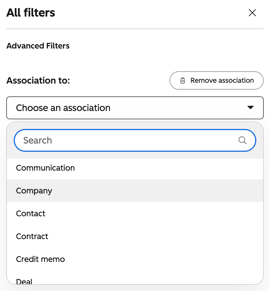
2. Column-Level Filtering on CRM tables [Live]
It is now possible to filter a CRM table view by a column in the view. This provides a quicker way to filter and view data without needing to add advanced filters.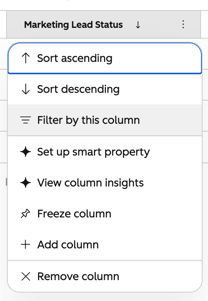
In your CRM table, click the vertical three dots (the kebab menu) on the column you want to filter by and then 'Filter by this column'.
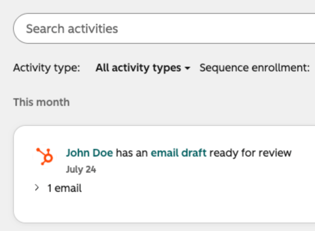
3. See Prospecting Agent email drafts in your activity feed [Live]
Emails drafted by the prospecting agent will now show as activity in the assigned sales rep's activity feed for the relevant contact. You can then quickly review and send emails created by the prospecting agent.
Something to read:
How AI text watermarking works.
AI text is watermarked. Not in the way you might think, either. Unlike images, videos and other content that contain metadata, plain text doesn't contain pixels with data in. Instead, the watermark is hidden in the AI’s word choices. They live in the choices between words. This article explains how it works and what you should know.